
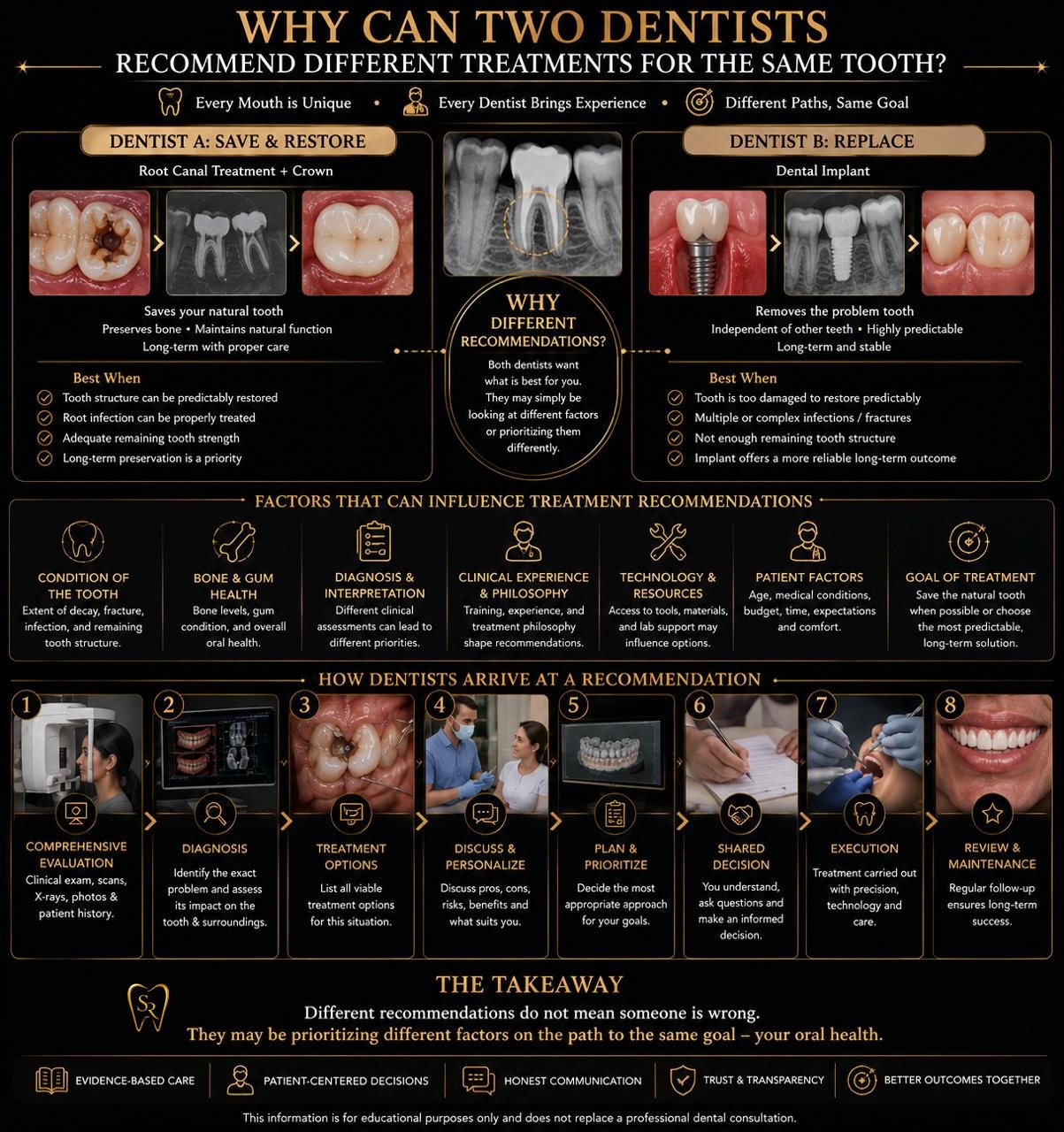
Why Can Two Dentists Recommend Different Treatments for the Same Tooth?
📅 Sep 1, 2026 | 🕒 5 min read | 👤 Dr. G. S. Suman Reddy
Two dentists can examine the same tooth and recommend different treatments—and that does not necessarily mean that one of them is wrong.
Dentistry involves both diagnosis and clinical judgement. While the diagnosis identifies the problem, the treatment recommendation also considers prognosis, remaining tooth structure, future risks, available alternatives and what matters to the individual patient.
Why Can Opinions Differ?

1. Diagnosis and prognosis are different?
Two dentists may agree about what is wrong with a tooth but assess its future differently.A tooth may technically be treatable, for example, while its long-term predictability remains uncertain.

2. There may be more than one reasonable treatment?
Modern dentistry often provides several possibilities.A damaged tooth might potentially be restored, treated endodontically, protected with a crown or, when its prognosis is poor, considered for extraction and replacement.The existence of alternatives does not automatically make one treatment superior in every patient.

3. Dentists may assess risk differently?
Remaining tooth structure, cracks, bone and gum support, bite forces, previous treatment and the likelihood of future complications all influence clinical judgement.One clinician may consider preservation worthwhile; another may feel the long-term risk makes a different approach more predictable.

4. Your priorities matter too?
Treatment planning is not based on the tooth alone. Longevity, treatment complexity, esthetics, maintenance, time, cost and a patient's preference for conservative or more definitive treatment can all influence the final decision.
Does a Different Opinion Mean You Should Be Concerned?
Not necessarily.
What matters is whether the dentist can clearly explain:
- What is the diagnosis?
- What are the reasonable options?
- What are the advantages and limitations of each?
- Why is one option being recommended for you?
If those answers are clear, differing opinions can actually help a patient make a better-informed decision.
The SR Perspective
A good treatment plan should not simply tell you what to do.
It should help you understand why.
When more than one reasonable treatment exists, the best decision is usually the one that balances preservation, predictability, biological cost and the patient's individual priorities.
Key Takeaway
Two competent dentists can sometimes recommend different treatments because treatment planning involves prognosis and clinical judgement—not diagnosis alone.
The important question isn't simply: "Which dentist is right?"
It is: "Which recommendation has the clearest clinical reasoning for my situation?"
