
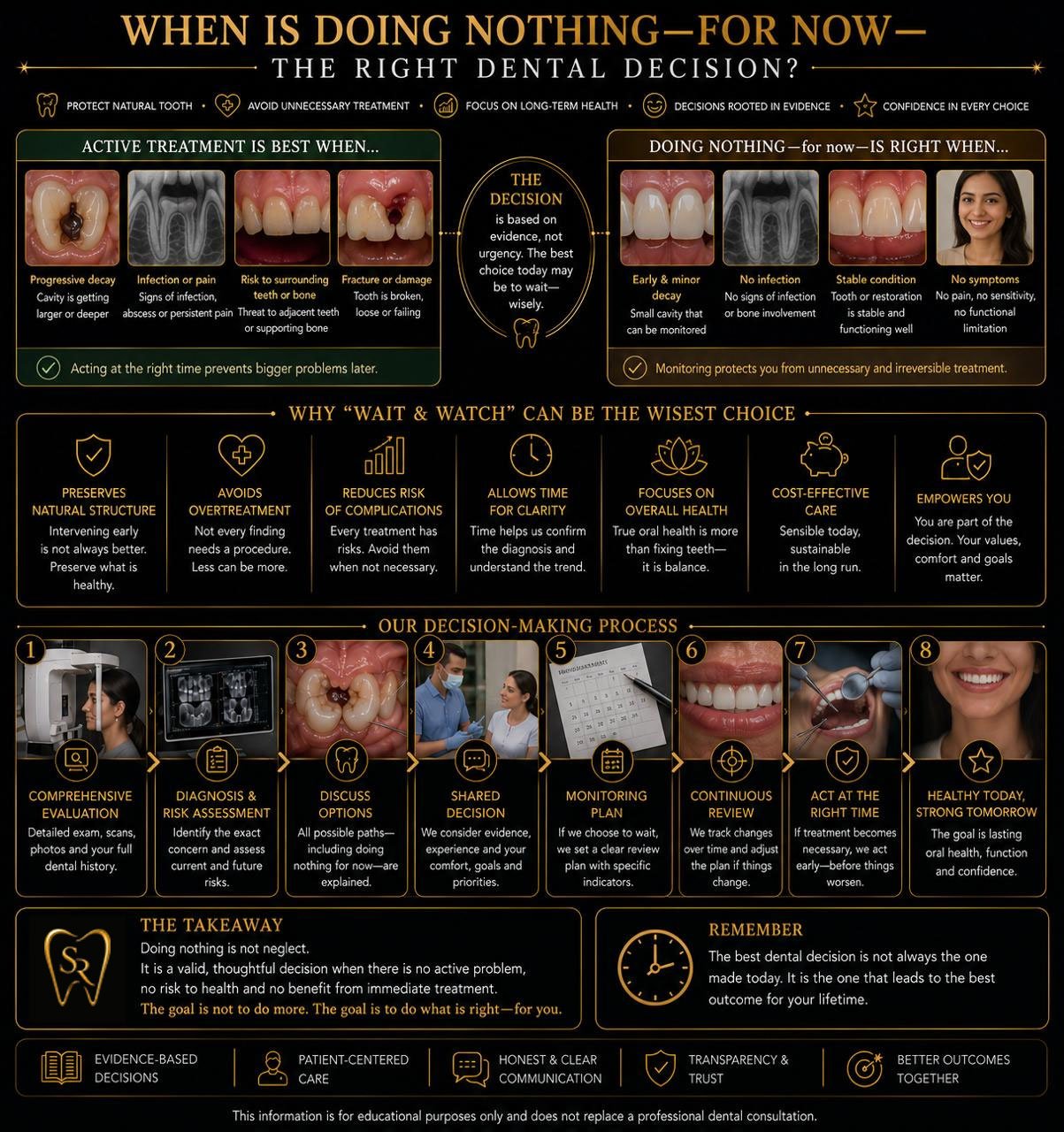
When Is Doing Nothing—for Now—the Right Dental Decision?
📅 Sep 1, 2026 | 🕒 5 min read | 👤 Dr. G. S. Suman Reddy
Finding a dental problem does not always mean it needs to be treated immediately.
In selected situations, careful monitoring can be more appropriate than immediate intervention—provided the condition is properly diagnosed, the risks are understood and follow-up is maintained.
The important distinction is between ignoring a problem and actively monitoring it.
When Can Monitoring Make Sense?

1. When a condition is stable
Some early or non-progressive findings may not justify immediate treatment.
If the expected benefit of intervention is small, documenting the condition and reviewing it over time can help determine whether treatment is actually necessary.

2. When treatment would remove healthy tooth structure
Dental treatment can have biological consequences.
Once healthy tooth structure is removed, it cannot be replaced naturally. This is why early intervention is not automatically better intervention.
When appropriate, preserving healthy tissue until there is a clear reason to treat can be the more conservative approach.

3. When more information is needed
Sometimes the best decision becomes clearer with time.
Clinical examinations, photographs, radiographs or digital records—when indicated—can allow a dentist to identify whether a condition is stable or changing.
Monitoring should therefore have a purpose and a review plan.

4. When the risks of treatment outweigh the immediate benefit
Every procedure has benefits, limitations and biological costs.
If treatment is unlikely to provide a meaningful advantage at that stage, carefully supervised observation may sometimes be reasonable.
When Is Waiting Not Appropriate?
Monitoring should never become an excuse to postpone necessary care.
Pain, swelling, infection, progressive disease, worsening symptoms or findings that threaten the tooth or surrounding tissues may require timely treatment.
The decision to wait should therefore be clinical—not simply convenient.
The SR Perspective
Good dentistry is often associated with what we can do.
Equally important is knowing when we should do it.
Doing less does not mean caring less.
When properly selected and monitored, choosing not to intervene immediately can be an active clinical decision designed to preserve healthy tissue and avoid unnecessary treatment.
Key Takeaway
Not every dental finding requires immediate treatment.
When a condition is stable and the benefits of intervention do not yet outweigh its biological cost, careful monitoring may be appropriate.
But observation should always be based on a diagnosis, defined follow-up and clear reasons for when treatment would become necessary.
