
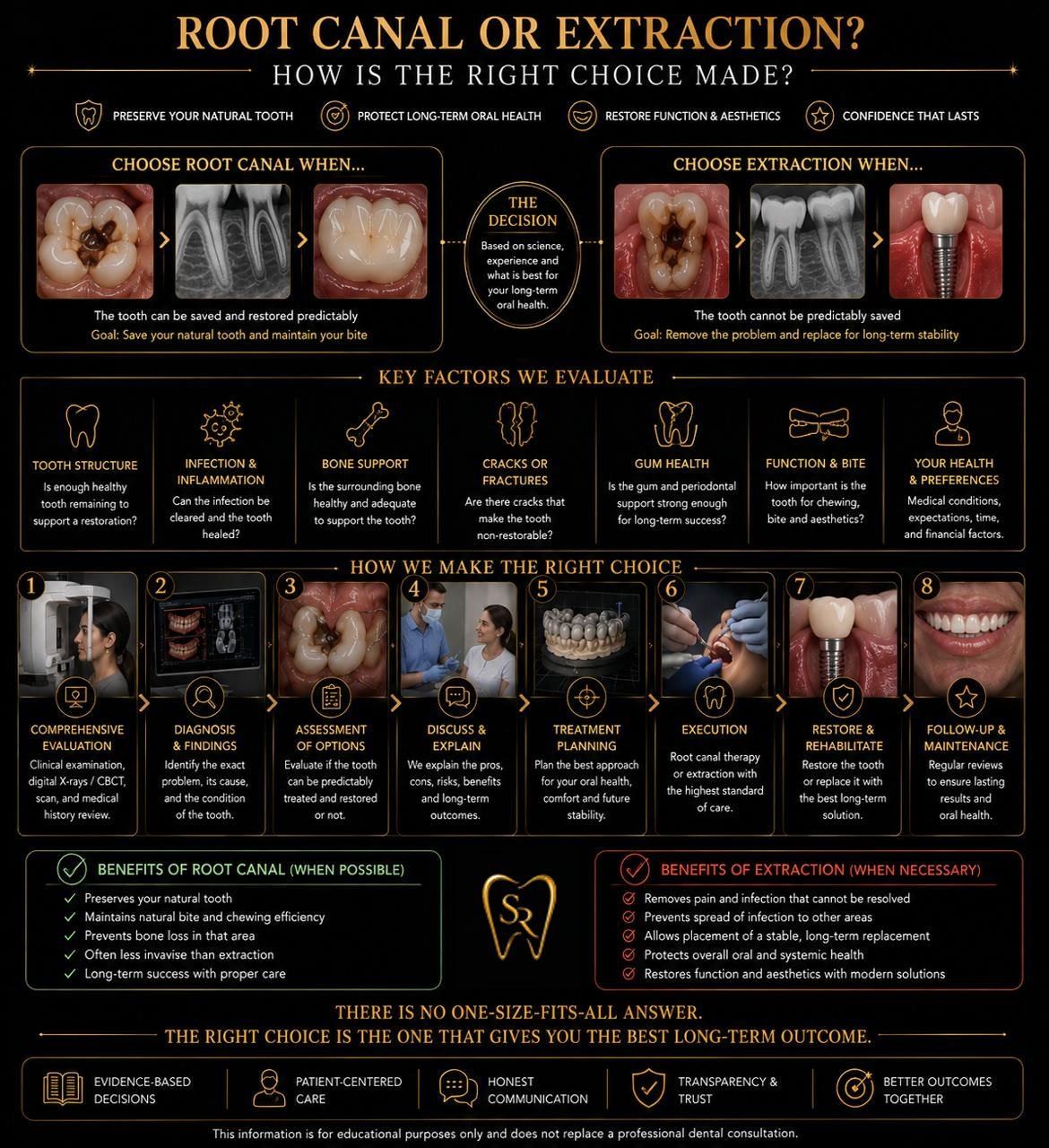
Root Canal or Extraction? How Is the Right Choice Made?
📅 Sep 1, 2026 | 🕒 5 min read | 👤 Dr. G. S. Suman Reddy
When a tooth is badly infected or damaged, patients are often presented with two very different choices: treat the tooth with a root canal or remove it.
A root canal is generally considered when the infection can be treated and the tooth can still be predictably restored and maintained. Extraction becomes more appropriate when structural damage, fracture, inadequate support or other factors make the tooth's long-term prognosis poor.
What Actually Determines the Choice?

1. Can the tooth be restored?
This is often the most important question.
Root canal treatment can address infection inside a tooth, but it cannot replace missing tooth structure or correct every type of fracture.
There must still be enough healthy, supported tooth remaining to create a durable final restoration.

2. What is the condition of the root and surrounding tissues?
The dentist evaluates the roots, infection, surrounding bone and gums, and whether previous treatment has affected the prognosis.
Some complex teeth can still be successfully treated. Others may technically be treatable but offer limited long-term predictability.

3. Is the tooth cracked?
Not every cracked tooth requires extraction.
What matters is where the crack extends and whether the remaining tooth can be predictably restored. Certain deep or unfavorable fractures can significantly change the prognosis.

4. What happens after extraction?
Removing the tooth may eliminate the immediate dental problem, but it also creates a missing tooth.
Depending on its location and function, the next decision may involve an implant, bridge, another replacement option—or occasionally whether replacement is necessary at all.
Is Extraction the Easier Option?
It can sometimes appear that way because removing the tooth may be quicker than trying to preserve it.
But quicker does not automatically mean better.
Likewise, repeatedly treating a tooth with a poor prognosis simply to avoid extraction may not be the best decision either.
The objective is to understand which option offers the better balance of preservation, predictability and long-term function.
The SR Perspective
The question should not be: "Can a root canal be done?"
It should be: "If we treat this tooth, can it be predictably restored and maintained?"
Preserving a natural tooth has real value when its prognosis justifies preservation. When it does not, extraction and appropriately planned replacement may provide the more predictable path.
Key Takeaway
Choose a root canal when the tooth can be predictably treated, restored and maintained—not simply because it can technically be treated.
When the tooth is structurally or biologically compromised beyond a reasonable prognosis, extraction may be the more appropriate decision.
