
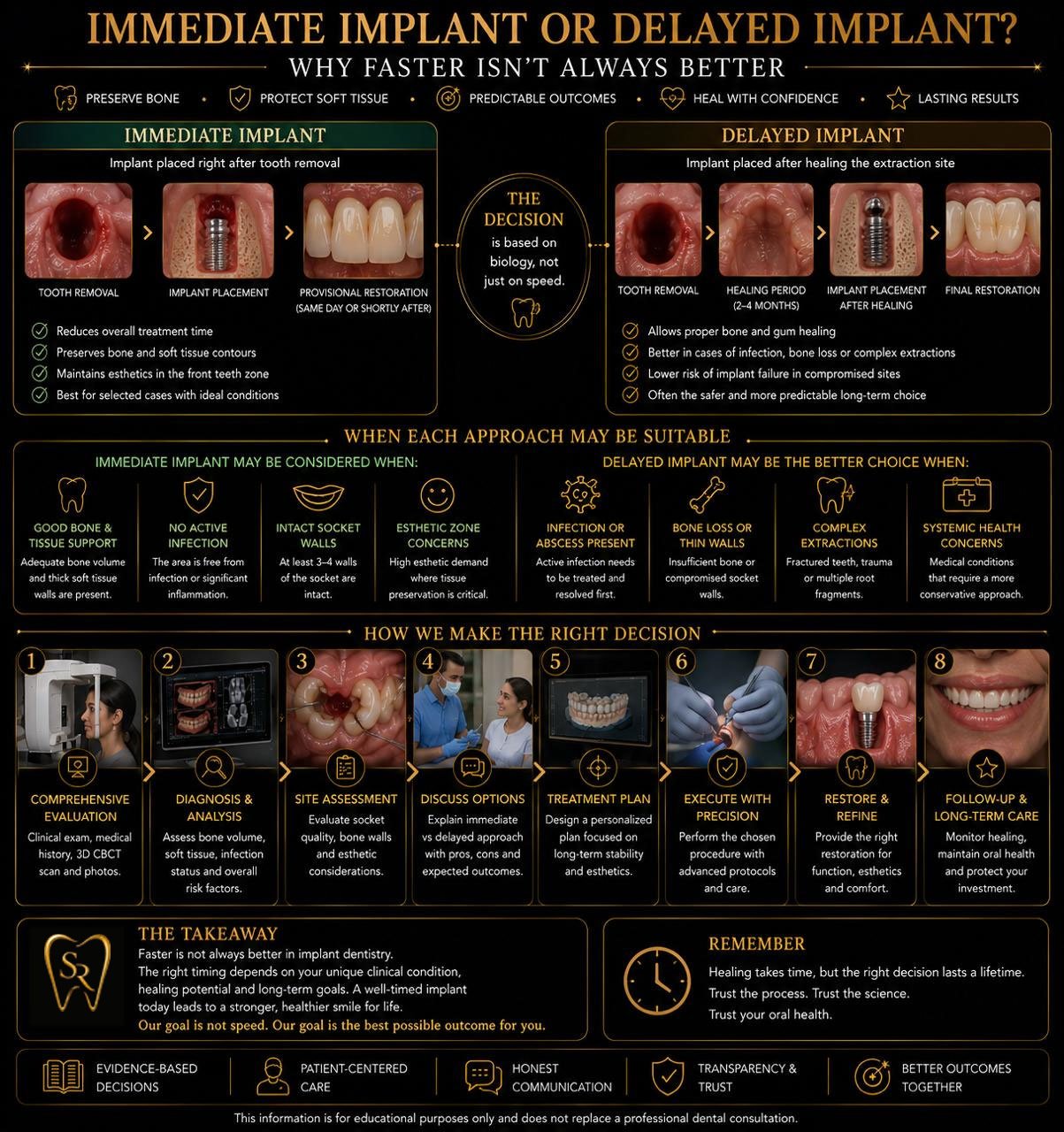
Immediate Implant or Delayed Implant? Why Faster Isn't Always Better
📅 Sep 1, 2026 | 🕒 5 min read | 👤 Dr. G. S. Suman Reddy
When a tooth needs to be removed, patients often ask: Can the implant be placed immediately?
Sometimes, yes—but immediate placement is not automatically the better choice. The right timing depends on the available bone, gum tissues, infection, implant stability, esthetic demands and whether the site can provide predictable conditions for healing.
What Is an Immediate Implant?
An immediate implant is placed into the extraction site at the same appointment in which the tooth is removed.
For appropriately selected cases, this can reduce the number of surgical stages and shorten the overall treatment pathway.
But faster treatment and better treatment are not necessarily the same thing.
What Determines the Right Timing?

1. Is there enough suitable bone?
An implant needs adequate bone in the right position to achieve stability.
If extraction leaves an unfavorable defect or insufficient supporting bone, rebuilding the site before or during implant placement may be more predictable.

2. What is the condition of the gums?
Implant dentistry is not only about bone.
The thickness, position and health of the surrounding soft tissues can strongly influence the final appearance and maintainability—particularly in the smile zone.

3. Is infection present?
The presence of infection does not automatically rule out immediate implant placement in every situation. However, the nature of the infection, condition of the socket and ability to thoroughly manage the site must be carefully evaluated.

4. Can the implant achieve the stability it needs?
Immediate placement requires suitable anatomy for the implant to be positioned securely and correctly.
If those conditions are not available, waiting can be a treatment decision—not a treatment delay.
Does Delayed Placement Mean Something Has Gone Wrong?
No. Sometimes allowing tissues to heal or rebuilding bone before placing the implant creates better conditions for the eventual restoration.
A staged approach may take longer, but when indicated, that additional time serves a biological purpose.
The SR Perspective
The attraction of completing treatment quickly is understandable.
But implant dentistry should not become a race against the calendar.
The question is not, "How soon can we place an implant?"
It is: "When can we place it under the best conditions for a predictable result?"
Immediate treatment can be excellent when the clinical conditions support it. When they do not, deliberately staging treatment may be the more sophisticated choice.
Key Takeaway
Immediate implants can reduce treatment stages in appropriately selected cases, but speed should never override biology, implant position or long-term predictability.
The best timing is the timing that provides the right conditions for the implant, surrounding tissues and final restoration.
