
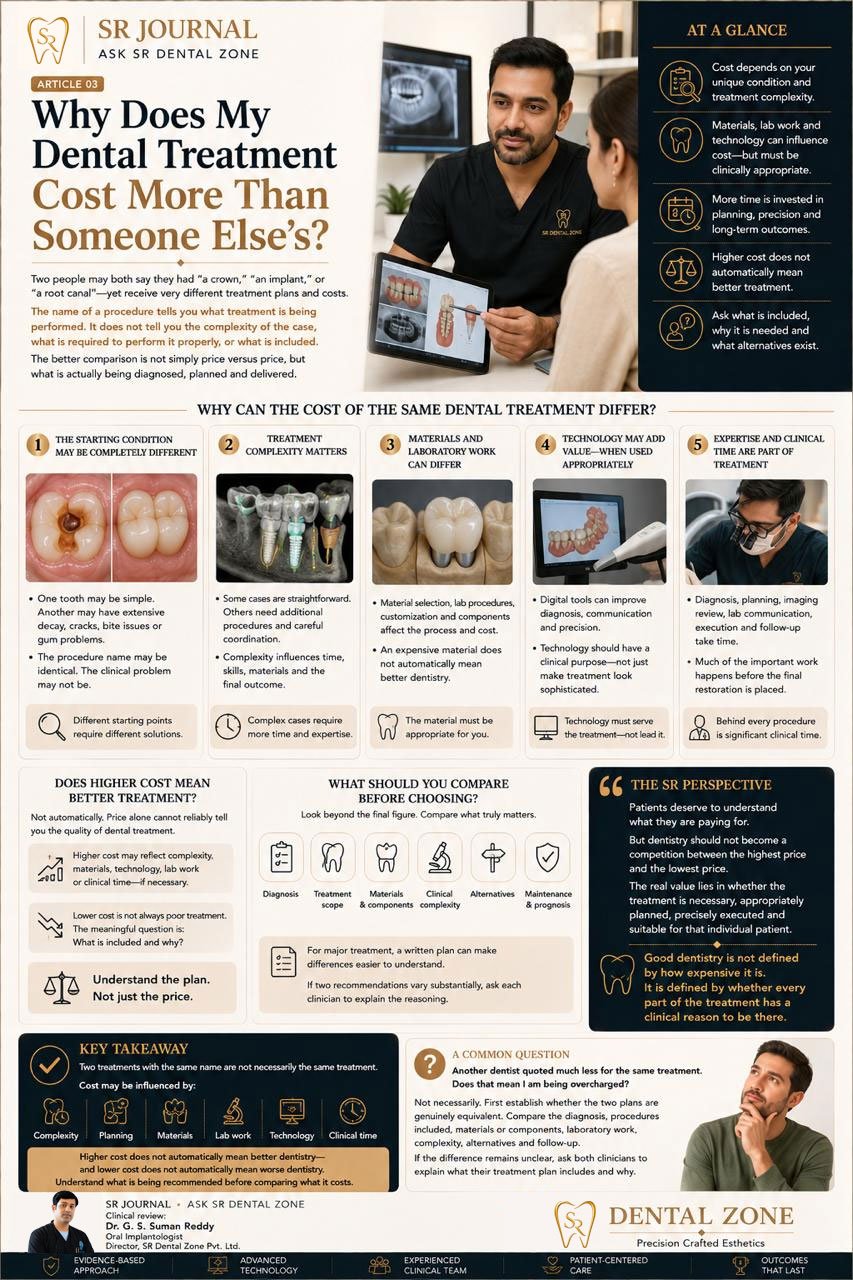
Why Does My Dental Treatment Cost More Than Someone Else's?
📅 Sep 7, 2026 | 🕒 5 min read | 👤 Dr. G. S. Suman Reddy
Two people may both say they had "a crown," "an implant," or "a root canal"—yet receive very different treatment plans and costs.
That does not necessarily mean one is being charged more for the same dentistry.
The name of a procedure tells you what treatment is being performed. It does not tell you the complexity of the case, what is required to perform it properly, or what is included in the treatment.
The better comparison is not simply price versus price, but what is actually being diagnosed, planned and delivered.
Why Can the Cost of the Same Dental Treatment Differ?

1. The starting condition may be completely different
No two teeth—or patients—begin from exactly the same situation.
One crown may involve a relatively intact tooth. Another may require management of extensive decay, a damaged foundation, bite-related problems or compromised gums before the final restoration can be made.
Similarly, one implant may be straightforward while another requires additional planning or management of deficient bone and soft tissue.
The procedure name may be identical. The clinical problem may not be.

2. Treatment complexity matters
Complex dentistry may require more appointments, additional procedures, greater planning and closer coordination between different stages of care.
A technically demanding anterior restoration, for example, may have very different requirements from a straightforward posterior restoration.
Cost can therefore reflect the complexity required to achieve an appropriate result, not simply the physical object being placed.

3. Materials and laboratory work can differ
Crowns, veneers, implant restorations and dentures are not all manufactured in exactly the same way.
Material selection, laboratory procedures, customization, characterization and the components used can influence both the treatment process and its cost.
But an important distinction remains:
A more expensive material does not automatically produce better dentistry.
The material must be appropriate for the clinical situation.

4. Technology may add value—but only when used appropriately
Digital scanning, 3D imaging, computer-guided planning and other technologies may improve diagnosis, communication or precision in selected situations.
They also involve equipment, software and clinical expertise.
However, technology should have a clinical purpose.
Using more technology simply to make treatment appear sophisticated does not necessarily improve the outcome.

5. Expertise and clinical time are part of treatment
Dental treatment involves more than the minutes spent performing a procedure.
Diagnosis, treatment planning, preparation, review of imaging, communication with the laboratory, execution and follow-up all contribute to the final result.
In complex cases, much of the important work happens before the definitive restoration is ever placed.
Does Higher Cost Mean Better Treatment?
Not automatically. Price alone cannot reliably tell you the quality of dental treatment.
A higher fee may reflect greater complexity, materials, laboratory involvement, technology or clinical time—but it should still be possible to explain why those elements are necessary for your case.
Likewise, the lowest quotation is not necessarily poor treatment.
The meaningful question is:
What exactly is included, why is it being recommended, and what alternatives exist?
What Should You Compare Before Choosing?
Rather than comparing only the final figure, ask about:
Diagnosis + Treatment scope + Materials/components + Clinical complexity + Alternatives + Maintenance + Expected prognosis
For major treatment, a written plan can make these differences easier to understand.
If two recommendations vary substantially, asking each clinician to explain the reasoning can be more useful than comparing procedure names alone.
The SR Perspective
Patients deserve to understand what they are paying for.
But dentistry should not become a competition between the highest price and the lowest price.
The real value lies in whether the treatment is necessary, appropriately planned, precisely executed and suitable for that individual patient.
Good dentistry is not defined by how expensive it is.
It is defined by whether every part of the treatment has a clinical reason to be there.
Key Takeaway
Two treatments with the same name are not necessarily the same treatment.
Cost may be influenced by:
Complexity + Planning + Materials + Laboratory work + Technology + Clinical time
Higher cost does not automatically mean better dentistry—and lower cost does not automatically mean worse dentistry.
Understand what is being recommended before comparing what it costs.
