
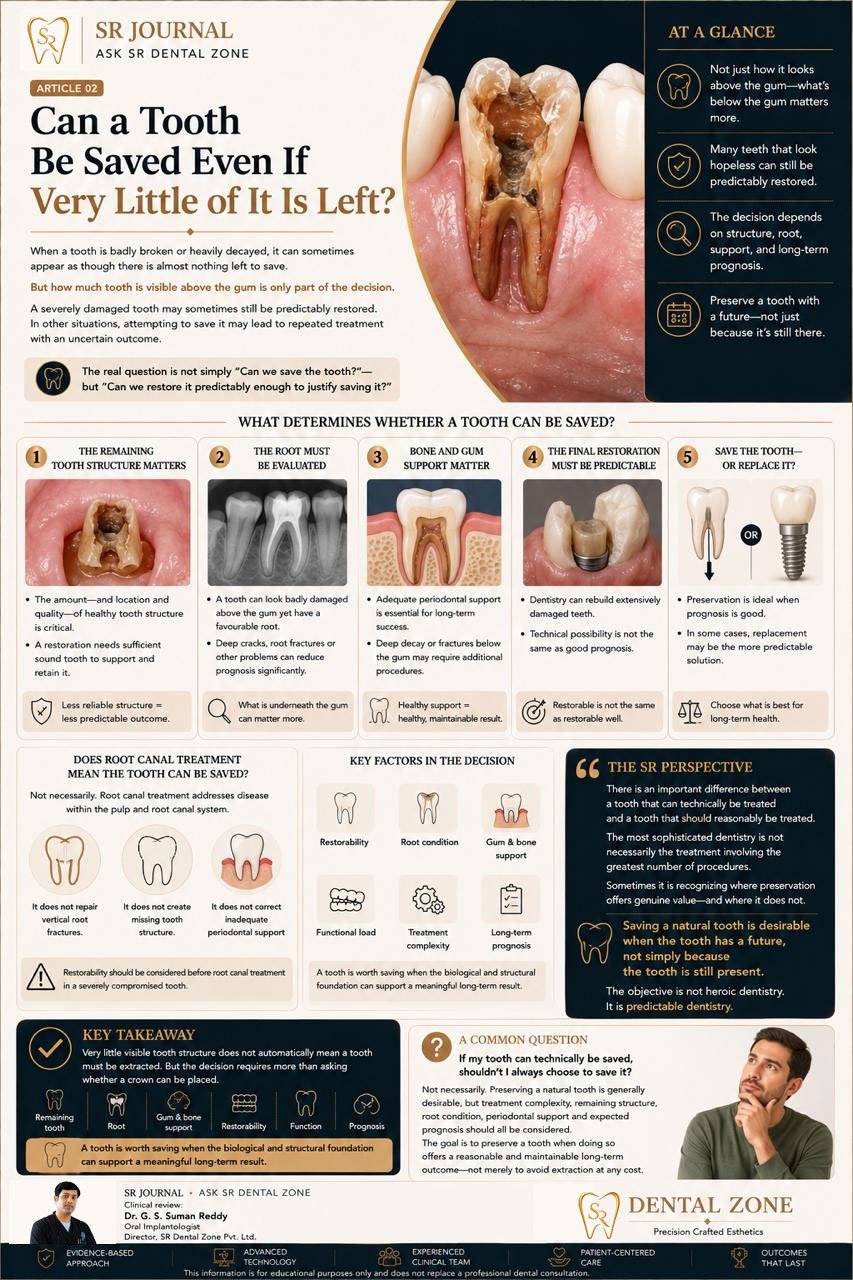
Can a Tooth Be Saved Even If Very Little of It Is Left?
📅 Sep 7, 2026 | 🕒 5 min read | 👤 Dr. G. S. Suman Reddy
When a tooth is badly broken or heavily decayed, it can sometimes appear as though there is almost nothing left to save.
But how much tooth is visible above the gum is only part of the decision.
A severely damaged tooth may sometimes still be predictably restored. In other situations, attempting to save it may lead to repeated treatment with an uncertain outcome.
The real question is not simply "Can we save the tooth?"—but "Can we restore it predictably enough to justify saving it?"
What Determines Whether a Tooth Can Be Saved?

1. The remaining tooth structure matters
The amount—and importantly, the location and quality—of healthy tooth structure is critical.
A restoration needs sufficient sound tooth to support and retain it.
When very little reliable structure remains, simply placing a larger filling or crown does not necessarily make the tooth stronger.

2. The root must be evaluated
A tooth can look badly damaged above the gum while still having a favourable root.
Conversely, a tooth with a reasonable-looking crown may have a deep crack, root fracture or other problem that significantly reduces its prognosis.
What is underneath the gum can matter more than what is visible above it.

3. Bone and gum support matter
Saving a tooth is not only about rebuilding the tooth itself.
The surrounding periodontal tissues must provide adequate support and allow the final restoration to remain healthy and maintainable.
If decay or fracture extends deeply below the gum, additional procedures may sometimes be required before the tooth can be restored appropriately.

4.The final restoration must be predictable
Modern dentistry can rebuild extensively damaged teeth—but technical possibility is not the same as good prognosis.
Before undertaking complex treatment, we should consider whether the finished tooth can withstand function, be cleaned effectively and remain maintainable over time.
Being able to restore a tooth is not automatically the same as being able to restore it well.
Does Root Canal Treatment Mean the Tooth Can Be Saved?
Not necessarily. Root canal treatment addresses disease within the pulp and root canal system.
It does not repair a vertical root fracture, create missing tooth structure or correct inadequate periodontal support.
Before root canal treatment is undertaken on a severely compromised tooth, its restorability should ideally be considered first.
Otherwise, a technically successful root canal may be completed on a tooth that still cannot be predictably restored.
Save the Tooth—or Replace It?
Whenever reasonably possible, preserving a natural tooth is valuable. But preservation should not become an objective at any cost.
The decision should consider: Restorability + Root condition + Periodontal support + Functional load + Treatment complexity + Long-term prognosis
In some situations, saving the tooth provides an excellent long-term solution.
In others, extraction followed by an appropriate replacement—or occasionally no immediate replacement—may provide the more predictable overall treatment plan.
The SR Perspective
There is an important difference between a tooth that can technically be treated and a tooth that should reasonably be treated.
The most sophisticated dentistry is not necessarily the treatment involving the greatest number of procedures.
Sometimes it is recognizing where preservation offers genuine value—and where it does not.
Saving a natural tooth is desirable when the tooth has a future, not simply because the tooth is still present.
The objective is not heroic dentistry. It is predictable dentistry.
Key Takeaway
Very little visible tooth structure does not automatically mean a tooth must be extracted.
But the decision requires more than asking whether a crown can be placed.
Consider: Remaining tooth + Root + Gum & bone support + Restorability + Function + Prognosis
A tooth is worth saving when the biological and structural foundation can support a meaningful long-term result.
