
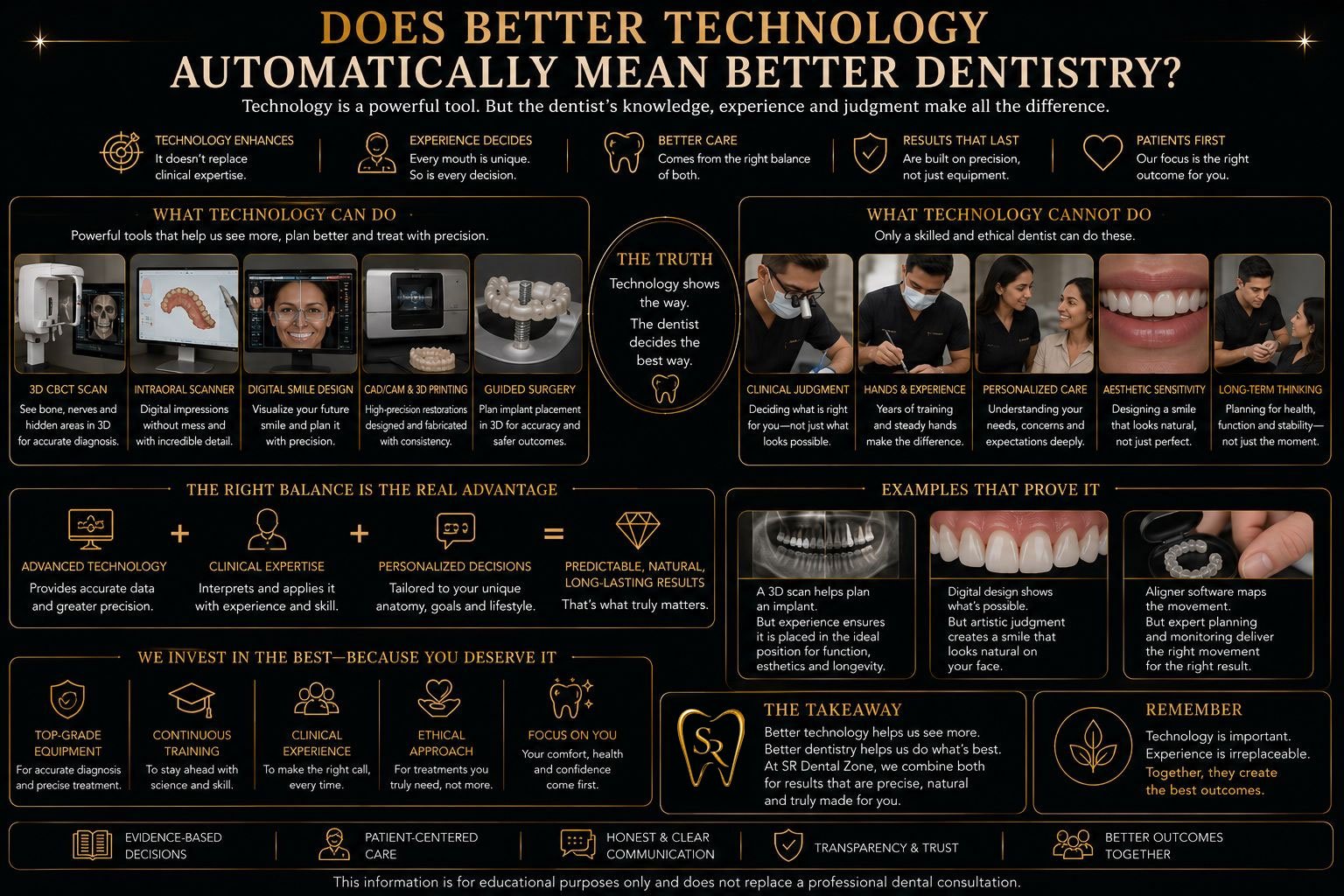
Does Better Technology Automatically Mean Better Dentistry?
📅 Sep 1, 2026 | 🕒 5 min read | 👤 Dr. G. S. Suman Reddy
Modern dentistry has access to increasingly sophisticated tools—from 3D imaging and digital scanners to guided surgery and computer-designed restorations.
But better technology does not automatically produce better dentistry. Technology improves care only when it is used appropriately, interpreted correctly and integrated into sound clinical judgement.
Where Does Technology Actually Add Value?

1. Better information
Digital imaging and scanning can reveal details that may be difficult to assess otherwise.
That can improve diagnosis, help identify anatomical limitations and reduce uncertainty before treatment begins.

2. Better planning
Technology can help the clinician visualise treatment before carrying it out.
For example, implant position, restorative space, bite relationships or tooth proportions can often be planned more precisely when digital data is available.

3. Better communication
Digital scans, photographs and simulations can make complex information easier for patients to understand.
When patients can clearly see the problem and proposed solution, treatment decisions become more informed.

4. Better execution—when the plan is right
Guides, digital workflows and computer-assisted procedures can improve consistency and precision.
But they still depend on a correct diagnosis and a well-designed treatment plan.
A precise execution of the wrong plan is still the wrong treatment.
Can Technology Replace Clinical Experience?
No. Technology can measure, display and simulate.
It cannot independently determine what is appropriate for a particular patient.
The clinician must still interpret the information, weigh risks, understand biology and decide whether intervention is justified.
The SR Perspective
The most advanced equipment in a clinic is valuable only when it improves how we think, plan or execute treatment.
Technology should support clinical judgement—not become a substitute for it.
The goal is not to use more technology. It is to use the right technology when it genuinely improves the decision or the outcome.
Key Takeaway
Technology can make dentistry more informed, precise and predictable—but only when it is paired with sound clinical judgement.
The quality of care depends not simply on what equipment is available, but on how thoughtfully that equipment is used.
