
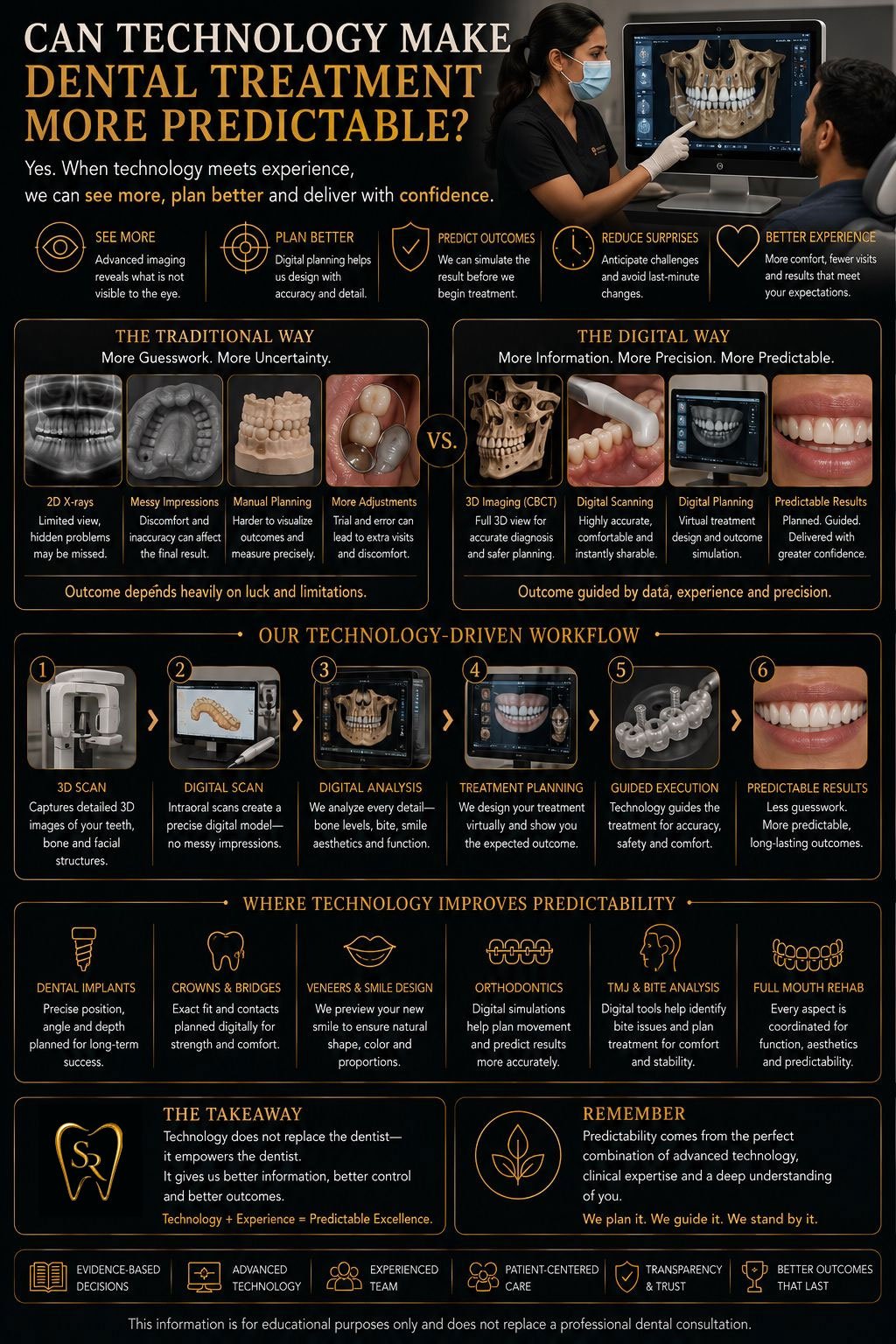
Can Technology Make Dental Treatment More Predictable?
📅 Sep 1, 2026 | 🕒 5 min read | 👤 Dr. G. S. Suman Reddy
Patients often hear that digital dentistry makes treatment more "predictable." But what does that actually mean?
Technology can improve predictability by helping clinicians collect better information, visualise treatment before it begins, identify limitations earlier and execute a well-designed plan more precisely. But it cannot guarantee an outcome.
Predictability comes from combining technology with biology, experience and clinical judgement.
How Can Technology Reduce Uncertainty?

1. Seeing more before treatment begins
Digital imaging, intraoral scans and clinical photography can provide different types of information about the teeth, bone, bite and surrounding tissues.
When appropriate, combining these records can create a more complete picture before treatment starts.

2. Planning the result in advance
Digital tools can allow parts of treatment to be planned virtually.
Implant position, restorative space, tooth proportions or the design of a future restoration may sometimes be evaluated before anything irreversible is done.
This allows potential limitations to be recognised earlier.

3. Transferring the plan more precisely
Planning has little value if it cannot be translated accurately into treatment.
Depending on the procedure, digital guides, computer-designed restorations and other workflows can help transfer aspects of the planned treatment to the clinical setting with greater control.

4. Checking rather than assuming
Digital records can also provide opportunities to compare, measure and verify.
Instead of relying entirely on visual judgement, clinicians may be able to evaluate whether important aspects of treatment correspond with what was originally planned.
Does Digital Planning Guarantee Success?
No. Dentistry takes place in living tissues.
Healing, bone quality, gum response, bite forces, oral hygiene, individual biology and patient maintenance can all influence outcomes.
Technology can help reduce some uncertainties. It cannot remove every biological variable.
The SR Perspective
Predictability should never be confused with certainty.
The purpose of technology is not to promise a perfect outcome.
It is to help us identify what we know, recognise what we do not know and reduce avoidable uncertainty wherever possible.
Technology makes its greatest contribution when it allows fewer important decisions to be left to chance.
Key Takeaway
Technology can make dental treatment more predictable—but not because computers guarantee success.
Its value lies in better information, advance planning, controlled execution and the ability to verify important details.
The strongest outcomes still depend on something technology cannot replace: sound diagnosis, respect for biology and good clinical judgement.
