
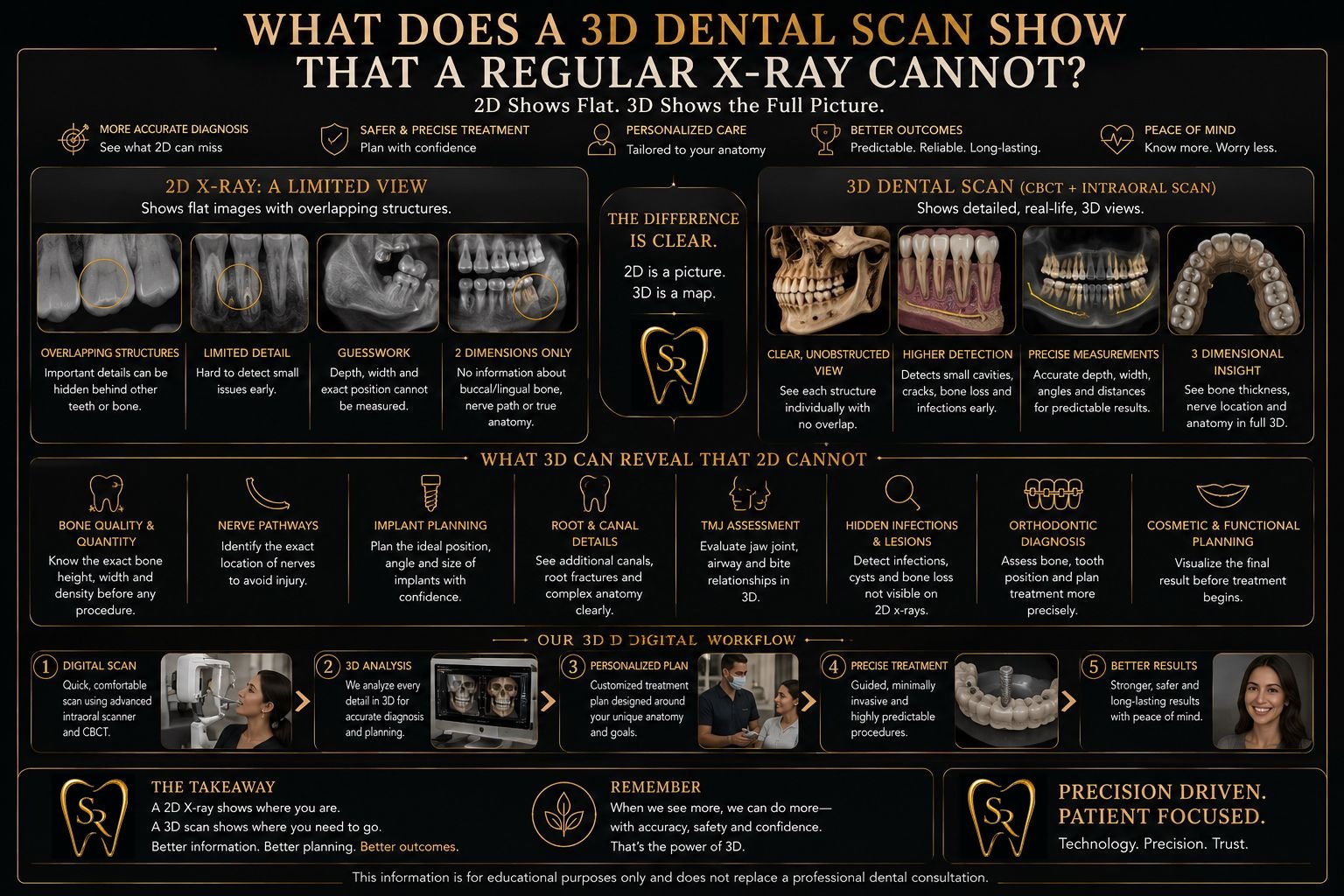
What Does a 3D Dental Scan Show That a Regular X-Ray Cannot?
📅 Sep 1, 2026 | 🕒 5 min read | 👤 Dr. G. S. Suman Reddy
Dental X-rays are extremely useful, but conventional X-rays show three-dimensional anatomy as a two-dimensional image.
A 3D dental scan—commonly called CBCT (cone beam computed tomography)—can provide a three-dimensional view of teeth, bone and surrounding anatomical structures. This can reveal spatial relationships that may not be clearly understood from a conventional dental X-ray alone.
What Does the Third Dimension Change?

1. It shows depth
A conventional X-ray can show height and width, but anatomical structures may overlap because depth is compressed into a flat image.
A 3D scan allows the clinician to examine the area from multiple planes and angles.
That additional information can matter when the exact position, shape or relationship of structures influences treatment.

2. It can show available bone more clearly
When planning dental implants, it is important to understand not only bone height but also bone width and three-dimensional anatomy.
CBCT can help assess the proposed implant site and its relationship to nearby anatomical structures.

3. It helps locate important anatomy
Depending on the area being examined, structures such as the mandibular nerve canal, maxillary sinus and neighbouring tooth roots may influence treatment planning.
Understanding where these structures lie in three dimensions can help the clinician plan more precisely.

4. It can clarify selected complex problems
In appropriate cases, 3D imaging can provide additional information when conventional examination and X-rays do not fully explain the clinical situation.
But that does not mean every dental problem requires a 3D scan.
Is a 3D Scan Always Better Than a Regular X-Ray?
NO. Different imaging methods answer different clinical questions.
A small dental X-ray may provide all the information required for many routine problems while using less radiation and being simpler to obtain.
CBCT should therefore be used when the additional three-dimensional information is expected to influence diagnosis or treatment planning—not simply because the technology is available.
The SR Perspective
Advanced imaging is valuable not because it produces a more impressive picture.
It is valuable when it helps us see something clinically important that changes how we understand or plan treatment.
Technology should never replace clinical judgement. Its real purpose is to give clinical judgement better information.
Key Takeaway
A regular dental X-ray and a 3D dental scan are not competing technologies—they answer different questions.
Conventional X-rays remain appropriate for many situations. A 3D scan becomes particularly valuable when depth, bone dimensions or the relationship between important anatomical structures needs to be understood.
The right imaging is not necessarily the most advanced imaging. It is the imaging that provides the information genuinely needed for the clinical decision.
