
Why Do My Gums Bleed When I Brush—and Should I Be Worried?
📅 Sep 7, 2026 | 🕒 5 min read | 👤 Dr. G. S. Suman Reddy
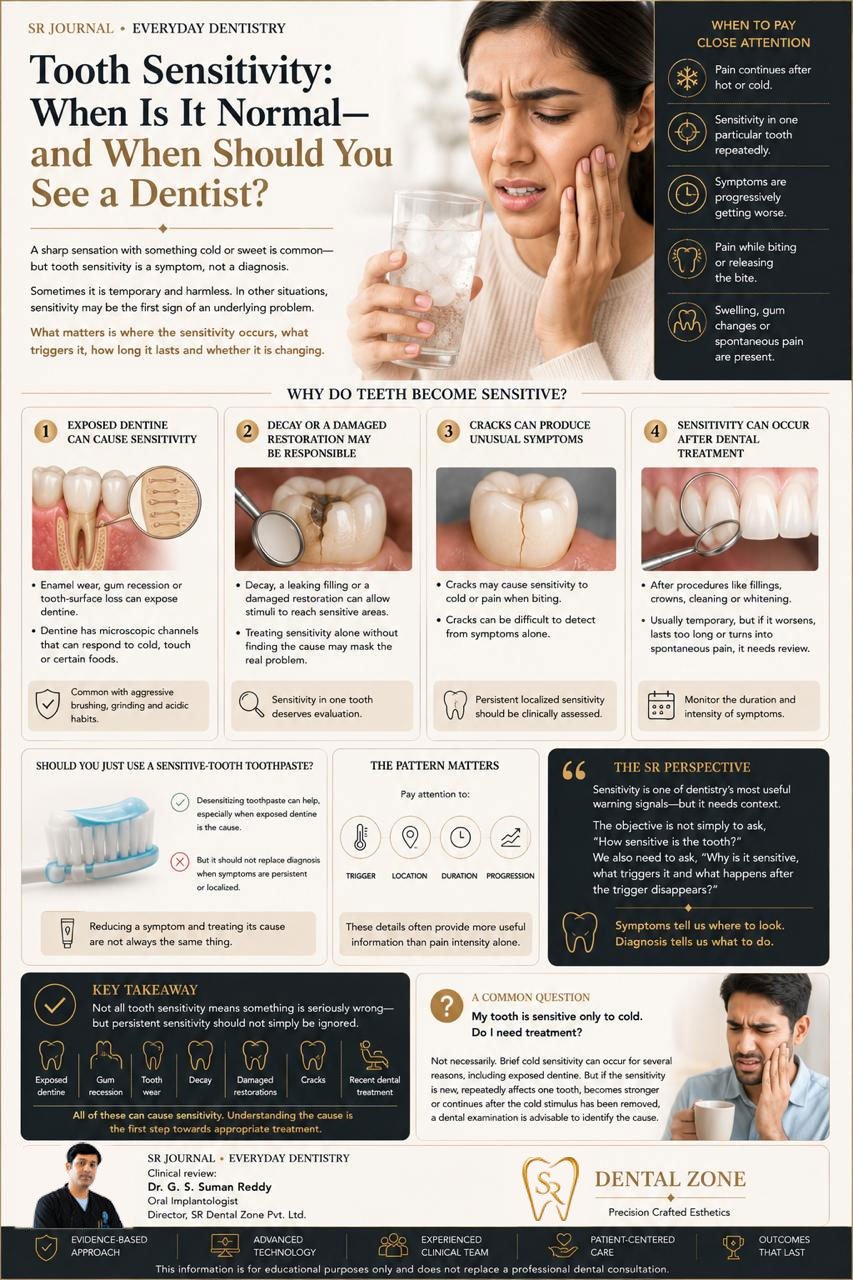
A sudden sharp sensation when drinking something cold or eating something sweet is common—but tooth sensitivity is a symptom, not a diagnosis.
Sometimes it is temporary and relatively harmless. In other situations, sensitivity may be the first sign of an underlying dental problem.
What matters is where the sensitivity occurs, what triggers it, how long it lasts and whether it is changing.
Why Do Teeth Become Sensitive?

1. Exposed dentine can cause sensitivity
Beneath the protective enamel of a tooth is dentine, which contains microscopic channels communicating with the inner part of the tooth. When dentine becomes exposed—often because of gum recession, enamel wear or tooth-surface loss—cold, touch or certain foods may produce a brief sharp sensation.

2. Decay or a damaged restoration may be responsible
Sensitivity affecting one particular tooth deserves attention.
Dental decay, a leaking or damaged filling, or another defect can allow stimuli to reach more sensitive areas of the tooth.
Treating the sensitivity alone without identifying its cause may therefore mask the real problem.
3. Cracks can produce unusual symptoms
A cracked tooth does not always cause constant pain.
Some cracks produce sensitivity to cold, while others cause discomfort when biting or particularly when releasing the bite.
Because cracks can be difficult to identify from symptoms alone, persistent localized sensitivity should be clinically assessed.

4. Sensitivity can occur after dental treatment
Teeth may sometimes become temporarily sensitive after procedures such as fillings, crowns, professional cleaning or whitening. This does not automatically indicate a problem. However, sensitivity that becomes increasingly severe, persists longer than expected or develops into spontaneous pain should be reassessed.
When Is Sensitivity More Concerning?
The pattern often tells us more than the intensity alone. A brief sensation that stops quickly after the trigger is removed may have a different significance from pain that continues afterwards. Professional assessment becomes particularly important when sensitivity:
- Occurs repeatedly in one tooth,
- Begins without an obvious trigger,
- Lingers after hot or cold,
- Is associated with biting pain,
- Becomes progressively worse, or
- Is accompanied by swelling or spontaneous pain.
Should You Just Use a Sensitive-Tooth Toothpaste?
Desensitizing toothpaste can be useful, particularly when exposed dentine is responsible. But it should not become a substitute for diagnosis when symptoms are persistent or localized.
Reducing a symptom and treating its cause are not always the same thing.
The SR Perspective
Sensitivity is one of dentistry's most useful warning signals—but it needs context.
The objective is not simply to ask: "How sensitive is the tooth?"
We also need to ask: "Why is it sensitive, what triggers it and what happens after the trigger disappears?"
That distinction can help separate a relatively simple sensitivity problem from a tooth that requires further investigation. Symptoms tell us where to look. Diagnosis tells us what to do.
Key Takeaway
Not all tooth sensitivity means something is seriously wrong—but persistent sensitivity should not simply be ignored.
Exposed dentine, gum recession, tooth wear, decay, damaged restorations, cracks and recent dental treatment can all produce sensitivity.
Pay attention to: Trigger + Location + Duration + Progression
These details often provide more useful information than pain intensity alone.
