
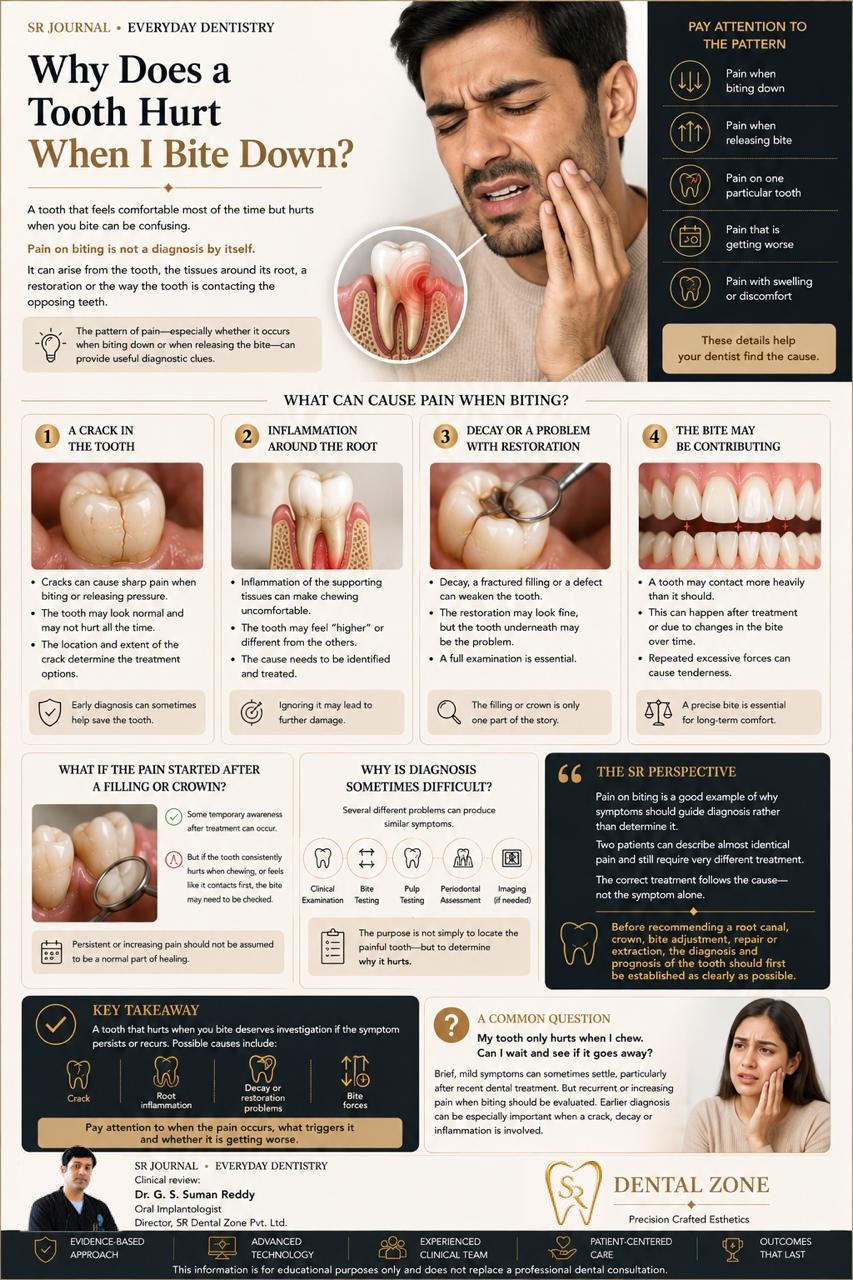
Why Does a Tooth Hurt When I Bite Down?
📅 Sep 7, 2026 | 🕒 5 min read | 👤 Dr. G. S. Suman Reddy
A tooth that feels comfortable most of the time but hurts when you bite can be confusing.
Pain on biting is not a diagnosis by itself. It can arise from the tooth, the tissues around its root, a restoration or the way the tooth is contacting the opposing teeth.
The pattern of pain—and especially whether it occurs when biting down or when releasing the bite—can provide useful diagnostic clues.
What Can Cause Pain When Biting?

1. A crack in the tooth
Cracked teeth can produce surprisingly inconsistent symptoms.
The tooth may look normal and may not hurt continuously, yet biting on something firm—or releasing pressure afterwards—can produce a sharp sensation.
The extent and location of a crack influence whether the tooth can be protected and restored or requires a different approach.

2. Inflammation around the root
When the tissues around the root of a tooth become inflamed, pressure from chewing can make the tooth feel tender.
Patients sometimes describe the tooth as feeling "higher" or different from the surrounding teeth.
The cause needs to be identified rather than simply avoiding chewing on that side.

3. Decay or a problem with an existing restoration
Decay, a fractured filling or another defect can weaken a tooth and produce discomfort under pressure.
Sometimes the restoration itself remains intact while the tooth underneath has changed.
The visible filling or crown is therefore only one part of the examination.

4. The bite may be contributing
Occasionally a tooth or restoration contacts the opposing teeth more heavily than intended.
This may occur after dental treatment or because the bite has changed over time.
Repeated excessive contact can make the tooth and surrounding tissues tender.
What If the Pain Started After a Filling or Crown?
Some temporary awareness after dental treatment can occur.
However, if a newly restored tooth consistently hurts when chewing or feels as though it contacts before the other teeth, the bite may need to be assessed.
Persistent or increasing pain should not simply be assumed to be part of normal healing.
Why Is Diagnosis Sometimes Difficult?
Several different problems can produce similar symptoms.
A crack may not always be obvious on an X-ray. Bite-related tenderness can resemble inflammation from another cause. Pain can occasionally even be perceived in a neighbouring tooth.
Diagnosis may therefore involve a combination of: Clinical examination + Bite testing + Pulp testing + Periodontal assessment + Imaging when indicated.
The purpose is not simply to locate the painful tooth—but to determine why it hurts.
The SR Perspective
Pain on biting is a good example of why symptoms should guide diagnosis rather than determine it.
Two patients can describe almost identical pain and still require very different treatment.
The correct treatment follows the cause—not the symptom alone.
Before recommending a root canal, crown, bite adjustment, repair or extraction, the diagnosis and prognosis of the tooth should first be established as clearly as possible.
Key Takeaway
A tooth that hurts when you bite deserves investigation if the symptom persists or recurs.
Possible causes include:
Crack + Root inflammation + Decay/restoration problems + Bite forces.
Pay attention to when the pain occurs, what triggers it and whether it is getting worse. Avoid repeatedly testing a painful tooth by biting hard objects to see whether it still hurts.
