
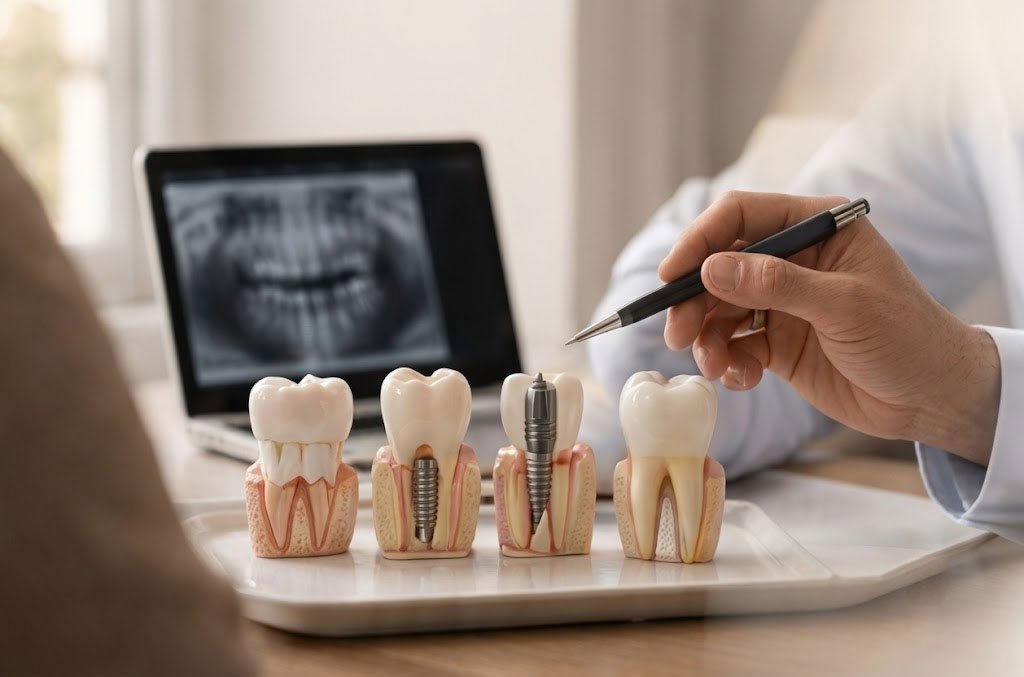
Why Does Modern Dentistry Sometimes Recommend More Than One Treatment Option?
📅 Sep 12, 2026 | 🕒 5 min read | 👤 Dr. G. S. Suman Reddy
A single dental problem can often have more than one clinically sound solution. The difference lies in what each option is designed to preserve, achieve and predict over time.
Patients sometimes expect a diagnosis to lead automatically to one treatment.
A cavity needs a filling. A painful tooth needs a root canal. A missing tooth needs an implant. Modern dentistry is rarely that simple.
The same clinical problem may reasonably be treated in different ways because treatment planning is not based on the diagnosis alone. It also considers biology, function, esthetics, longevity, risk and the priorities of the individual patient.
That does not necessarily mean there is uncertainty about what is wrong. It often means there is more than one responsible way to manage it.
1. The Diagnosis Is Only the Beginning
A diagnosis describes the problem. A treatment plan asks a more complex question:
What is the most appropriate way to manage this problem for this particular patient?
Consider a badly damaged tooth. Depending on how much healthy tooth structure remains, the condition of the nerve and surrounding bone, the patient's bite and several other factors, reasonable options might include restoring the tooth, performing root canal treatment and restoring it, or removing and replacing it.
The diagnosis provides the starting point. The treatment decision requires interpretation.
2. Different Treatments Solve Different Priorities
Two treatments may both be clinically acceptable while offering different advantages.
One may preserve more natural tooth structure. Another may offer greater mechanical predictability. One may provide the best esthetic result. Another may be simpler, less invasive or easier to maintain.
This is why the question is not always: "Which treatment is best?"
A better question is: "Which treatment offers the best balance for this situation?"
3. Longevity Matters — but So Does Preservation
Modern dentistry increasingly values conservative treatment: preserving healthy enamel, dentin, bone and soft tissue whenever reasonably possible. But preservation should not be confused with keeping something at any cost.
A technically possible treatment may carry an uncertain long-term prognosis. Conversely, replacing a tooth too early may sacrifice biological structures that could have been preserved successfully for many years.
Good treatment planning therefore considers both what can be saved today and what is likely to remain predictable tomorrow.
4. Function Changes the Decision
Teeth do not work independently. The way the upper and lower teeth meet, grinding or clenching habits, missing neighbouring teeth, previous restorations and the forces placed on a particular tooth can substantially influence treatment.
A restoration that performs beautifully under moderate forces may be less predictable in a heavily loaded part of the mouth. This is one reason apparently similar dental problems may receive different recommendations.
5. Esthetics Is Part of the Decision — Not the Entire Decision
In visible areas, colour, shape, symmetry and gum architecture may influence the choice of treatment. But good esthetic dentistry should not pursue appearance at the expense of biology.
The most sophisticated treatment is often the one that achieves the desired improvement while requiring the least unnecessary intervention.
6. Technology Gives Us More Information, Not Automatic Answers
Digital scans, CBCT imaging, magnification, photography and digital treatment planning allow dentists to understand clinical situations with remarkable detail. Yet technology does not make the decision by itself.
Its real value is helping the clinician assess anatomy, risk and possible outcomes more accurately — and helping the patient understand those choices. Technology should improve judgment, not replace it.
7. Your Priorities Matter Too
Treatment planning is ultimately a shared clinical decision. Some patients place the greatest importance on preserving their natural tooth. Others prioritise longevity, esthetics, treatment time, comfort or financial considerations.
These preferences do not replace sound clinical principles, but they are legitimate parts of choosing between clinically appropriate alternatives.
A thoughtful consultation should therefore explain not only what can be done, but also: what each option preserves, what it requires, its limitations, its likely longevity and what may happen if treatment is postponed.
The SR Perspective
At SR Dental Zone, we believe presenting appropriate alternatives is not indecision. It is part of responsible treatment planning. The objective is not to provide the greatest number of options, nor to recommend the most complex treatment.
It is to understand the biology, evaluate the evidence, recognise the trade-offs and identify the treatment that makes the most sense for the individual patient. Because precision in dentistry is not simply performing a procedure accurately.
It begins with choosing the right procedure — for the right reason.
Key Takeaway
When your dentist presents more than one treatment option, ask:
What are we trying to preserve?
What are the advantages and compromises of each approach?
How predictable is each option over time?
What happens if I wait?
The quality of a treatment decision is not measured by how quickly an option is chosen. It is measured by how well that choice is understood.
Frequently Asked Questions
Not necessarily. Many dental conditions genuinely have more than one clinically acceptable solution. The important part is understanding why each option is being considered.
Not automatically. Longevity is important, but so are biological preservation, invasiveness, function, esthetics, maintainability and individual circumstances.
No. Cost does not determine clinical appropriateness. The best option is the one that provides the most appropriate balance of benefits, risks and long-term predictability for your situation.
A second opinion can be useful when the diagnosis is complex, treatment would be irreversible or extensive, or you would simply like another clinical perspective before making an important decision.
