
Why the Most Natural Smile Is Rarely the Whitest Smile?
📅 Sep 1, 2026 | 🕒 5 min read | 👤 Dr. G. S. Suman Reddy
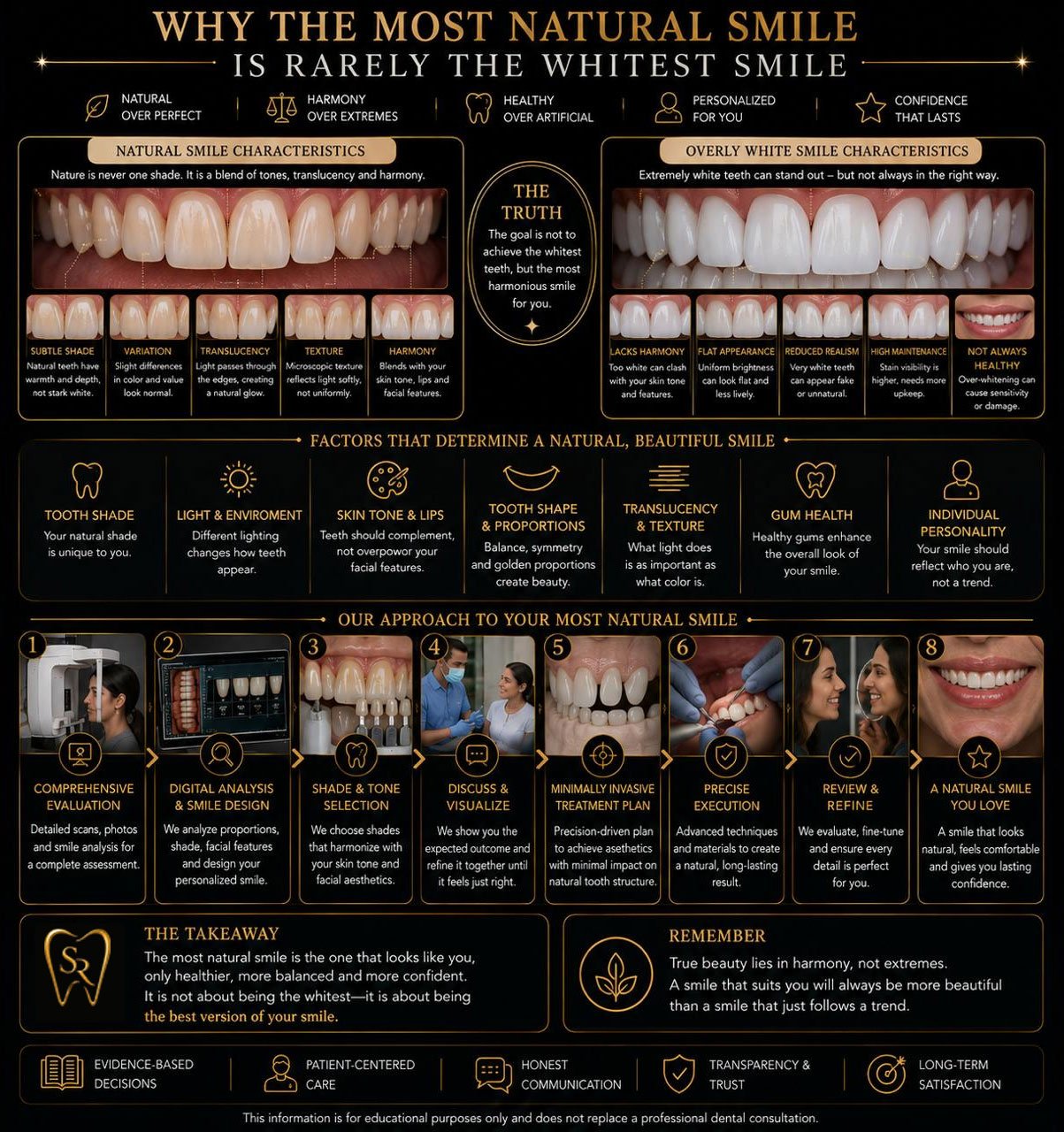
When patients imagine a better smile, whiter teeth are often the first thing that comes to mind. But a naturally beautiful smile is rarely defined by shade alone.
The most convincing smiles balance tooth colour with translucency, shape, proportion, surface texture, gums, lips and the face around them.
What Actually Makes a Smile Look Natural?

1. Natural teeth aren't one flat shade
Healthy teeth contain subtle variations in colour and translucency. Light interacts differently with enamel and the underlying tooth structure, creating depth.
When teeth become excessively white, opaque or uniform, some of this natural character can disappear.

2. Whiter isn't always more flattering
The right tooth shade should complement the person's complexion, lips, age and overall facial appearance.
A shade that looks beautiful on one person may appear unnatural on another.
The goal should therefore not necessarily be the whitest shade available, but the shade that creates the most harmonious result.

3. Shape and proportion matter just as much
Two smiles with exactly the same tooth shade can look completely different.
Tooth width and length, symmetry, edges, spacing and the relationship between neighbouring teeth all influence how we perceive a smile.
Sometimes improving these proportions can make a greater esthetic difference than changing colour.

4. Small imperfections can create natural character
Natural smiles are not mathematically identical.
Subtle differences in texture, translucency and tooth form help teeth interact naturally with light.
Esthetic dentistry becomes particularly convincing when these details are respected rather than erased.
Does This Mean Teeth Shouldn't Be Whitened?
Not at all. Professional whitening can brighten a smile while preserving the natural tooth structure and character.
The important question is not: "How white can my teeth become?"
It is: "What shade will look naturally right for me?"
For some patients, whitening alone may provide the change they want. Others may have concerns involving shape, position, wear or existing restorations that require a different approach.
The SR Perspective
A beautiful smile should attract attention to the person—not the dentistry.
The objective of esthetic treatment is not to create the same bright, perfectly uniform smile for everyone.
It is to understand the individual relationship between teeth, gums, lips and face and enhance it without losing natural character.
The best esthetic result often looks less like treatment—and more like it was always meant to be there.
Key Takeaway
The most natural smile is not necessarily the whitest smile.
Shade matters, but translucency, tooth form, proportions, texture and facial harmony determine whether a smile ultimately looks natural.
The right smile should not simply be brighter. It should belong to you.
