
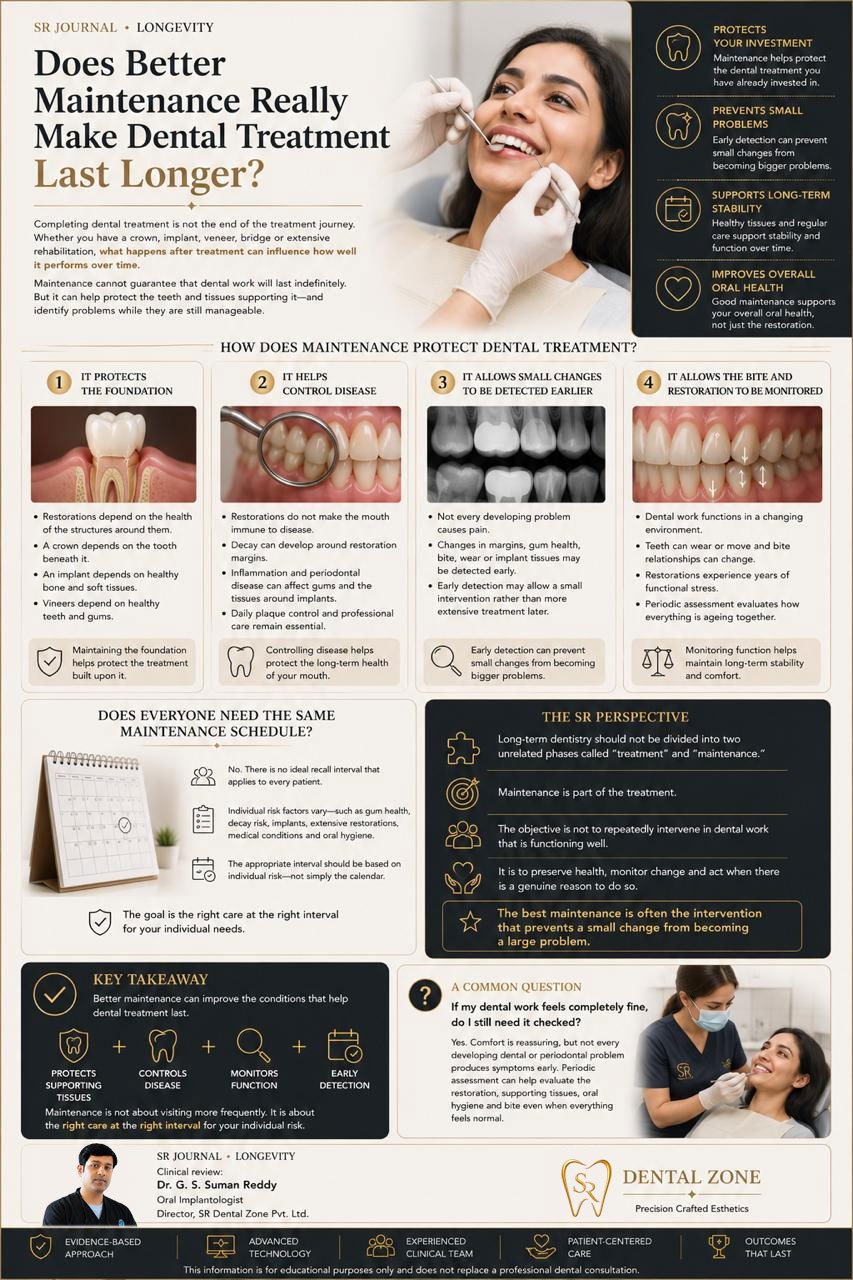
Does Better Maintenance Really Make Dental Treatment Last Longer?
📅 Sep 7, 2026 | 🕒 5 min read | 👤 Dr. G. S. Suman Reddy
Completing dental treatment is not the end of the treatment journey.
Whether you have a crown, implant, veneer, bridge or extensive rehabilitation, what happens after treatment can influence how well it performs over time.
Maintenance cannot guarantee that dental work will last indefinitely. But it can help protect the teeth and tissues supporting it—and identify problems while they are still manageable.
How Does Maintenance Protect Dental Treatment?

1. It protects the foundation
Restorations depend on the health of the structures around them.
A crown still depends on the tooth beneath it. An implant depends on healthy surrounding bone and soft tissues. Veneers depend on healthy teeth and gums.
Maintaining the foundation helps protect the treatment built upon it.

2. It helps control disease
Dental restorations do not make the mouth immune to future disease.
Natural teeth can still develop decay around restoration margins, while inflammation and periodontal disease can affect the tissues surrounding teeth and implants.
Effective daily plaque control and appropriate professional care therefore remain important after treatment.

3. It allows small changes to be detected earlier
Not every developing problem causes pain.
Changes in restoration margins, gum health, bite, wear or implant tissues may sometimes be identified during examination before the patient notices anything unusual.
Early detection may allow a relatively small intervention rather than more extensive treatment later.

4. It allows the bite and restoration to be monitored
Dental work functions in a changing environment.
Teeth can wear or move, bite relationships can change and restorations themselves can experience years of functional stress.
Periodic assessment allows the dentist to evaluate how the restoration and the surrounding mouth are ageing together.
Does Everyone Need the Same Maintenance Schedule?
No. There is no ideal recall interval that applies to every patient.
Someone with excellent periodontal health and low disease risk may have different maintenance requirements from a patient with implants, previous gum disease, extensive restorative work or a higher risk of decay.
The appropriate interval should therefore be based on individual risk—not simply the calendar.
The SR Perspective
Long-term dentistry should not be divided into two unrelated phases called "treatment" and "maintenance."
Maintenance is part of the treatment. The objective is not to repeatedly intervene in dental work that is functioning well. It is to preserve health, monitor change and act when there is a genuine reason to do so.
The best maintenance is often the intervention that prevents a small change from becoming a large problem.
Key Takeaway
Better maintenance can improve the conditions that help dental treatment last.
It protects supporting teeth and tissues, helps control disease, monitors function and allows developing problems to be identified earlier.
But maintenance is not simply about visiting the dentist more frequently.
It is about receiving the right care at the right interval for your individual risk.
